
The results of NASA’s highly competitive “Deep Space Food Challenge: Mars to Table” have been announced a few weeks ago, casting a well-deserved spotlight on a forward-thinking company from Belgium. Astrofood, based in the municipality of Ellezelles, has been officially recognized by NASA as an outstanding international team for its pioneering system: the Food Resilience Ecosystem for Space Habitats (FRESH).
The Mars to Table challenge tasked multidisciplinary teams with a daring engineering and biological hurdle: designing complete, Earth-independent, and integrated food systems for long-duration human missions to the Martian surface. Operating under extreme constraints, these systems must minimize reliance on fragile supply chains while ensuring crew health, morale, and peak performance over multi-year expeditions.
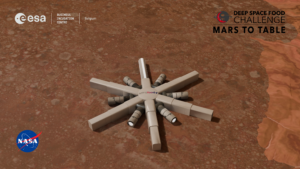
Astrofood NASA DSFC FRESH Base
Astrofood’s FRESH system stood out for its integrated approach to sustainable food production, combining greenhouse cultivation, automated microalgae photobioreactors, AI-driven monitoring, robotics and circular resource management. Building on technologies developed with ESA support, including a technology transfer facilitated by ESA Tech Broker Belgium, the system uses the AstroLoop digital twin to coordinate astronaut nutrition, biological production and resource recovery. Designed to meet 100% of the crew’s planned dietary calorie requirements on Mars, FRESH aims to minimise dependence on Earth resupply while maintaining nutritional diversity, food safety and operational resilience throughout long-duration missions.
Beyond its applications for future astronauts, the FRESH architecture carries deep implications for sustainability here on Earth. Food systems engineered to survive the resource-scarce environment of Mars often translate directly into solutions for our own pressing terrestrial challenges, from improving urban food resilience to deploying reliable nutrition in remote communities and disaster zones.
For a European enterprise to achieve this level of distinction in a US-administered initiative underscores that the push toward deep space exploration relies on a truly global brain trust, with vital contributions originating right in the heart of Europe. As humanity prepares for sustained missions to neighboring planets, the ingenuity of European innovators will clearly play an essential role in sustaining us among the stars.