
Antwerp-based Tusk IC successfully closed a €15m Series A round in September 2026. The capital injection was led by Matterwave Ventures, FORWARD.one, and the Flanders Future Tech Fund, alongside the Schaubroeck family office. The new resources will allow the company to scale its chips from prototype to high-volume commercial manufacturing.
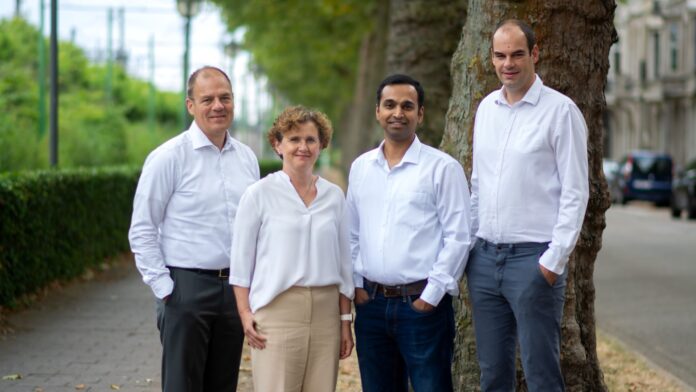
Tusk IC’s management team. From left to right: Paul Muller (VP business development), Kathleen Philips (CEO), Shailesh Kulkarni (CTO), and Wouter Volkaerts (COO).
The company (a KU Leuven spin-off) specializes in highly integrated, energy-efficient mmWave chips and modular active antennas. Their Ka band integrated circuits and Active antenna modules are meant for flat-panel antennas designed to provide continuous, non-mechanical tracking for Satcom-on-the-Move (SOTM) applications, which are essential for commercial aircraft, maritime fleets, defense vehicles, and the automotive industry. By leveraging mature mass-volume CMOS fabrication processes, Tusk IC managed to create a European alternative to Starlink flat-panel antennas.
“We are grateful for the trust our investors have placed in us and for the confidence our customers and partners continue to show.” said Kathleen Philips, CEO of TUSK IC.
This funding milestone highlights the quiet strength of Europe’s collaborative innovation environment. The complex leap from academic research to commercial deep-tech hardware was facilitated by the Belgian and European ecosystems.
Verhaert, acting as the ESA Tech Broker for Belgium, supported Tusk IC in its internal technology transfer from non-space applications to satellite communications (a “spin-in” in ESA jargon). Besides this, the company has also been able to secure ESA’s direct support with the award of a contract within ESA’s ARTES program.
With robust financial backing and an established foundation of institutional support, Tusk IC is now positioned to strengthen Europe’s resilience and competitiveness in the advanced satellite communications supply chain. For the deep-tech sector, this raise is an encouraging reminder that targeted ecosystem collaboration and rigorous engineering can effectively scale to meet the demands of a connected global future.